 Quickswap
Quickswap V2 liquidity earns swap fees while relative price changes alter token exposure
Quickswap V2 liquidity earns swap fees while trading changes the position's exposure to each token. Providing liquidity commits both assets to a pool and gives you LP tokens representing a share of its balances. Impermanent loss measures the shortfall against holding the same starting tokens outside the pool. Fees can offset that shortfall, but the outcome depends on relative price movement, trading volume and your share of liquidity. A positive fee return doesn't establish a better result than holding.
V2 trading fees already form part of the withdrawal value, so adding them again overstates a liquidity position's return.
Reserve ratios and changing token exposure
V2's constant-product reserves connect fee income with changing exposure as traders add one asset to the pool and remove some of the other. Arbitrage trades bring the pool's relative price toward prices elsewhere. To move the pool toward a token's higher relative price, traders remove that token and add its partner. Your LP share follows that mix.
A wallet retaining the starting quantities keeps its original token exposure. The pool adjusts exposure as people trade, giving up some upside during a sustained relative price move. Both assets can rise in a common valuation currency while the LP position still trails holding. Both can also fall. Absolute profit or loss and impermanent loss answer different questions, so a positive balance change doesn't settle whether supplying liquidity improved the outcome.
V2 deposit proportions and ownership parameters
Adding liquidity through the V2 router matches token amounts to an existing pool's reserve ratio in raw token units. Each token's decimals determine the corresponding human-readable quantities. Equal value at the pool price doesn't mean equal token counts. A mismatched direct deposit can donate excess tokens because LP minting follows the smaller proportional contribution. The router reverts a deposit if the reserve-matched amount falls below its minimum or execution occurs after the deadline. Those limits address price movement during entry; they don't restrict how the position's token mix changes afterward.
| Parameter | Classic V2 value or rule | Accounting effect |
|---|---|---|
| Reserve assets | 2 ERC-20 tokens | Each pair fixes its two token addresses. |
| Existing-pool deposit ratio | Current reserve ratio | The router matches deposit amounts to reserves. |
| Reserve curve | x × y = k before fees | Fee-paying swaps increase k. |
| LP ownership fraction | L / S | L is the LP balance; S is total LP supply. |
| LP token precision | 18 decimals | Raw LP units use this decimal scale. |
| Initial locked liquidity | 1 000 smallest LP token units | The first mint locks this amount permanently. |
In the curve formula, x and y are reserve balances and k is their product. The LP share uses the balance and total supply of the same pair contract. Supply includes the locked initial units. New liquidity and protocol fee minting can change your fraction, so an ownership estimate from entry isn't a permanent share. Withdrawals reduce supply as the pool burns redeemed LP units.
Swap fees retained in reserves
The classic V2 swap charge and the provider's share of fee growth are different quantities, so the trading fee alone doesn't establish LP income. The classic V2 pair contract charges 0.30% of the token amount received as swap input. That fee stays within the pool's balances. LP holders participate through their claim on those balances, which also change with trading.
The factory's
feeTo
setting controls whether protocol fee accounting is active. A nonzero recipient enables it. On liquidity additions or removals, the contract can mint LP tokens to that recipient from reserve-product growth. Income calculations therefore need the deployed factory's current fee configuration.
Protocol fee minting increases total LP supply, reducing existing holders' proportion. It doesn't increase the pair's swap charge.
Swap fee accrual doesn't add more LP tokens to your wallet. Existing units redeem against the pool's evolving balances. An unchanged LP token count can therefore accompany fee earnings. A higher position value alone can't isolate those earnings from asset price effects.
When do V2 fees outweigh impermanent loss?
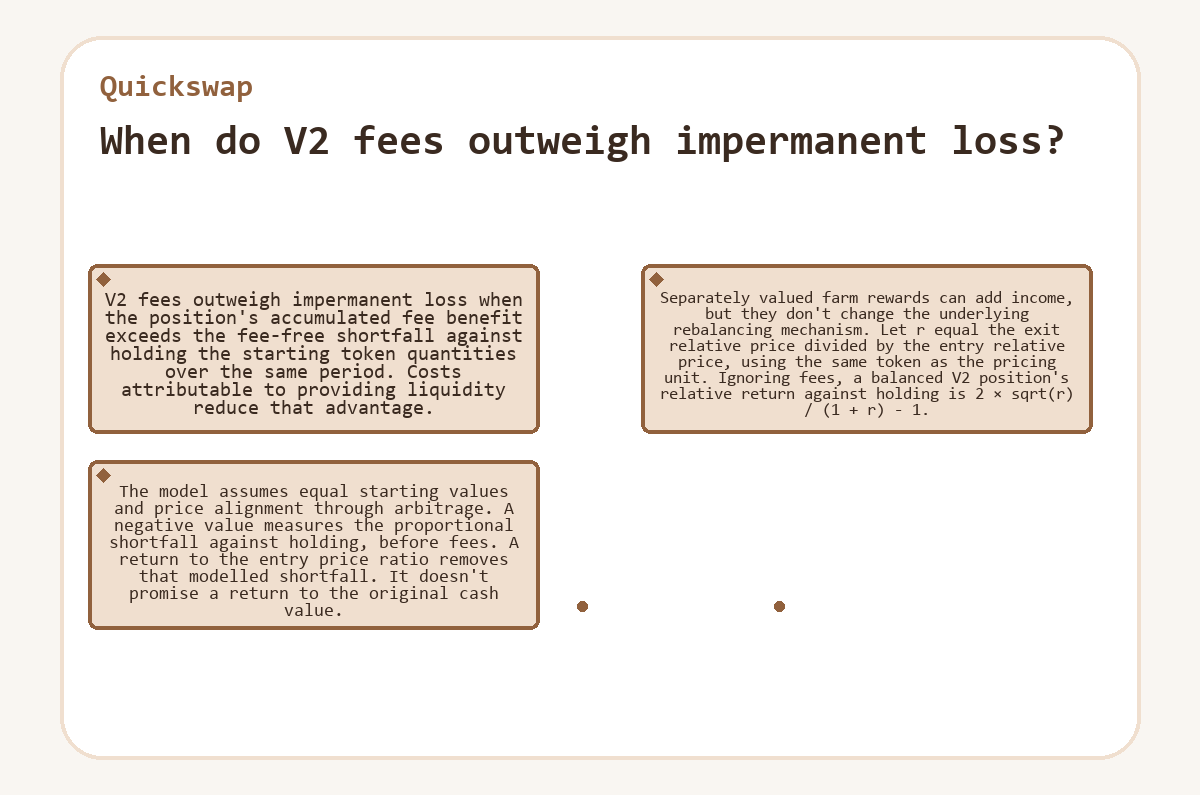
V2 fees outweigh impermanent loss when the position's accumulated fee benefit exceeds the fee-free shortfall against holding the starting token quantities over the same period. Costs attributable to providing liquidity reduce that advantage. Separately valued farm rewards can add income, but they don't change the underlying rebalancing mechanism.
Let r equal the exit relative price divided by the entry relative price, using the same token as the pricing unit. Ignoring fees, a balanced V2 position's relative return against holding is 2 × sqrt(r) / (1 + r) - 1. The model assumes equal starting values and price alignment through arbitrage. A negative value measures the proportional shortfall against holding, before fees.
A return to the entry price ratio removes that modelled shortfall. It doesn't promise a return to the original cash value.
Pool volume and separate farming rewards
Fee income follows trading volume relative to liquidity, while farm rewards depend on a separate incentive programme available only for eligible positions. More swap volume generates more gross fees at an unchanged fee rate. More competing liquidity divides those fees among more LP units. A pool with substantial deposits can earn less in fees per dollar of liquidity than a smaller pool receiving similar volume. Repeated trading also explains why endpoint prices alone can't predict total fee income.
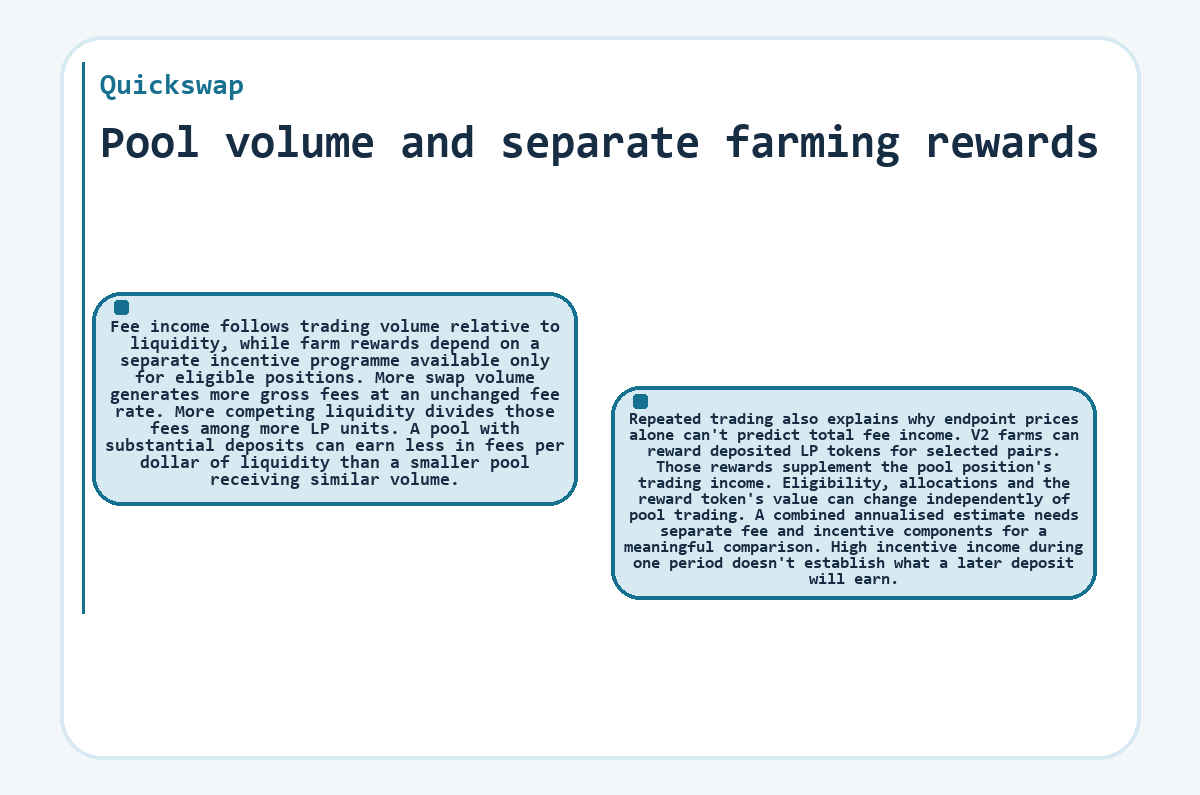
V2 farms can reward deposited LP tokens for selected pairs. Those rewards supplement the pool position's trading income. Eligibility, allocations and the reward token's value can change independently of pool trading. A combined annualised estimate needs separate fee and incentive components for a meaningful comparison. High incentive income during one period doesn't establish what a later deposit will earn.
Withdrawal values and net proceeds
Liquidity removal converts LP tokens into a proportional share of the pool's balances at execution, so the returned quantities can differ from those originally deposited. The contract burns the redeemed LP units and transfers both underlying assets. Trading fees already sit within those balances. Adding a separate estimate of the same fees to the withdrawal value would count them twice.
Network fees reduce the economic benefit of entry and exit. Their cost depends on the network and the transactions actually required.
A holding benchmark values the original token quantities using the same endpoint prices as the withdrawn assets. This keeps market movement separate from the liquidity strategy. Later deposits and partial withdrawals require corresponding additions or deductions in the holding benchmark. Include farm rewards at their relevant value, then deduct costs attributable to the LP position. If the intended outcome requires swapping withdrawn tokens, include that conversion's fees and price impact too.
V2 liquidity, holding and concentrated ranges
V2 keeps liquidity available across its full price curve, while holding preserves token quantities and concentrated liquidity limits active capital to a selected price range. V2 therefore avoids the need to choose and maintain an active range. Its broader distribution can use capital less efficiently than in-range concentrated liquidity. The V2 loss formula doesn't describe a concentrated position's range-dependent exposure.
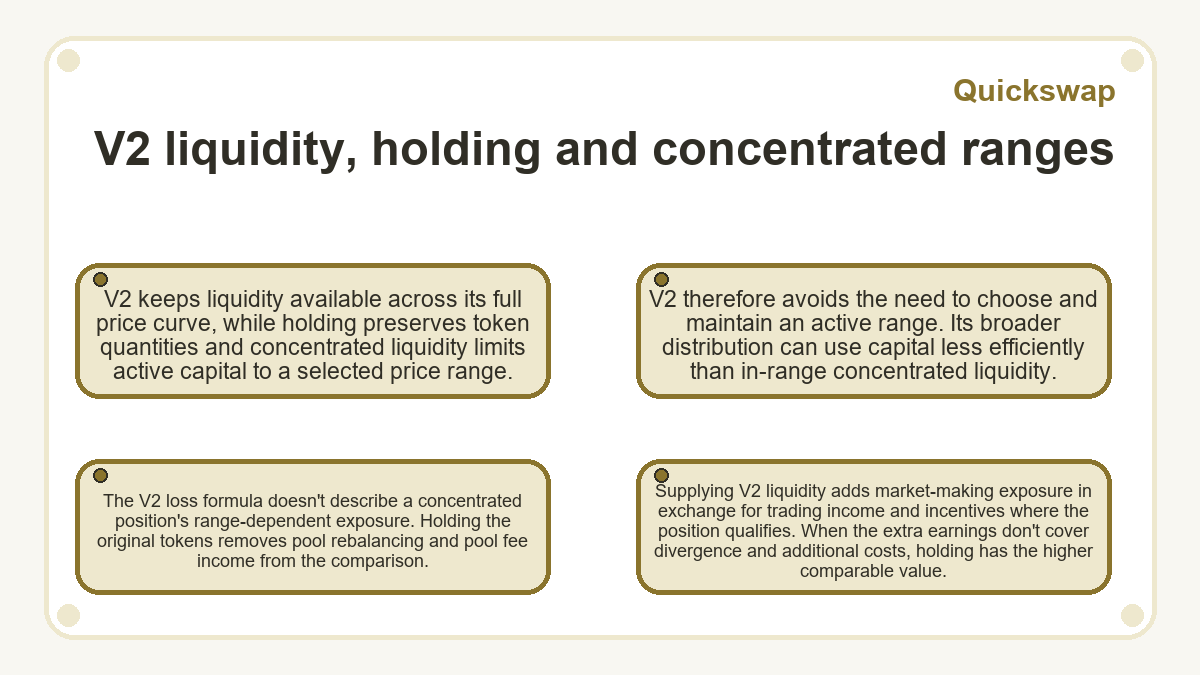
Holding the original tokens removes pool rebalancing and pool fee income from the comparison. Supplying V2 liquidity adds market-making exposure in exchange for trading income and incentives where the position qualifies. When the extra earnings don't cover divergence and additional costs, holding has the higher comparable value.
Things people ask about Quickswap
Can I remove only part of a V2 liquidity position?
Yes, the standard V2 router can redeem a selected portion of your LP tokens. The pair burns that portion and returns its proportional claim on both underlying balances. The LP units you keep retain their reserve claim and continue participating in fee growth. A partial withdrawal doesn't select only the stronger token or reverse earlier rebalancing. If you staked those units, access also depends on the farm's withdrawal mechanism.
Why do different V2 positions display the same LP token symbol?
Classic V2 pair contracts share the UNI-V2 symbol even though each pair has a separate contract address. The address distinguishes which reserves an LP token represents. Matching symbols don't establish the same redemption claim. LP balances for separate contracts don't combine into one ownership percentage. The relevant balance and total supply belong to the same pair contract.
Does an expired liquidity-removal deadline lock my V2 funds?
No, an expired router deadline causes that liquidity-removal transaction to revert. The deadline controls the permitted execution time for that call; it isn't a holding period for the LP position. The LP tokens remain unredeemed when the call reverts. The standard pair doesn't add a new lock because of that deadline.
Which minimum amounts matter when withdrawing V2 liquidity?
The standard V2 router's removeLiquidity method checks the pair's reported token amounts against amountAMin and amountBMin. If either amount falls below its minimum, the router reverts the call. These limits constrain execution as the pool ratio changes; they don't compensate for impermanent loss. A token charging a transfer tax can make the recipient's actual amount differ from the pair's reported output.
Is a stablecoin V2 pool immune to impermanent loss?
No, a stablecoin V2 pair can experience impermanent loss when the tokens' relative value changes. A relative price near its entry level limits the fee-free shortfall in the constant-product model. If one token loses its peg, arbitrage can move more of that weakening token into the pool. Targeting the same value doesn't establish equal market prices throughout the deposit period.
Will transferring V2 LP tokens transfer their accrued trading fees?
Yes, transferring V2 LP tokens transfers their claim on the pool's balances, including retained trading fees. The current holder owns that reserve claim, including changes accumulated before the transfer. The recipient also receives exposure to the pool's changing token mix. The transfer doesn't withdraw either reserve asset, so it differs from burning LP tokens to remove liquidity.