 Quickswap
Quickswap concentrated liquidity earns swap fees when trades use liquidity within your chosen range
Quickswap concentrated liquidity lets you choose the price interval where a V3 position supplies assets for swaps. A narrow interval concentrates the deposit around fewer prices; a wider interval allows more movement before the position leaves its range. Fees accrue when trades use your active liquidity. Range selection also determines the required token mix and how that mix changes with price. A useful range reflects expected relative-price movement and the cost of keeping liquidity active.
Range selection when the pool price moves
A manual deposit supplies active liquidity when the pool price lies inside its bounds; crossing a bound before funding changes the required assets. The range's boundaries are your chosen settings. The pool price is a live input.
A band around the pool price
An existing, initialized pool supplies the live price used to size a manual deposit. Comparing widths uses the same pair and price orientation. Widening an enclosing band here means extending both bounds away from that price. An interior price requires both assets in range-dependent amounts.
| Range option | Capital placement | Price movement before exit | Assets needed at entry |
|---|---|---|---|
| Narrow band enclosing the pool price | Capital concentrates in a smaller interval | A nearer boundary limits movement | Both pool tokens in range-dependent amounts |
| Wider band enclosing the same price | Capital covers a larger interval | More movement fits between the bounds | Both pool tokens in range-dependent amounts |
| Full Range | Capital spans the widest valid interval | No custom interior boundary to cross | Both pool tokens at an interior price |
A crossed boundary before funding
A price move beyond your selected band makes the prospective deposit single-sided. Refreshing the deposit amounts accounts for that change. A successfully funded, unchanged band would start inactive at the new price. Liquidity intended for swaps at the updated price needs bounds enclosing that price. Recalculating amounts won't move those bounds. After a successful deposit, the recorded ticks and liquidity, together with the pool's live tick, establish active status. A changing fee quote doesn't change this rule.
Range width and monitoring costs
Range width balances concentrated capital against the price movement a position can absorb, so monitoring effort and transaction costs belong in the same decision. Recent price history can show movement relative to the other pool asset, without predicting the next move. A wider band may reduce how often maintaining active liquidity calls for repositioning. A tighter band puts more capital into a smaller interval and can need more frequent attention. Even assets intended to track the same value can diverge, leaving a tight band inactive.
Fee income from active liquidity
Active liquidity earns the provider portion of swap fees in proportion to its share at the prices a swap crosses. More competing liquidity at the same prices dilutes that share. Total pool value can include inactive positions and doesn't establish your fee share.
Range width changes capital concentration, while the selected pool's fee mechanism determines the swap charge. Algebra-based V3 pools can use dynamic fees, while fixed-tier deployments use fee-specific pools. The relevant pool configuration governs which model applies.
An in-range label shows price eligibility for swap fees without establishing trading volume or net profit.
Annualized fee estimates extrapolate from observations and assumptions about traded volume, active liquidity and the pool fee. Changes in those inputs alter the estimate. Farming rewards follow separate incentive rules, so a combined yield figure needs its fee and incentive components kept distinct. A narrow position with little trading activity can collect fewer fees than a broader position experiencing sustained flow.
Which token remains when the price leaves the range?
A manual position holds the base token below its range and the quote token above it, when price means quote tokens per base token.
Trading within the interval
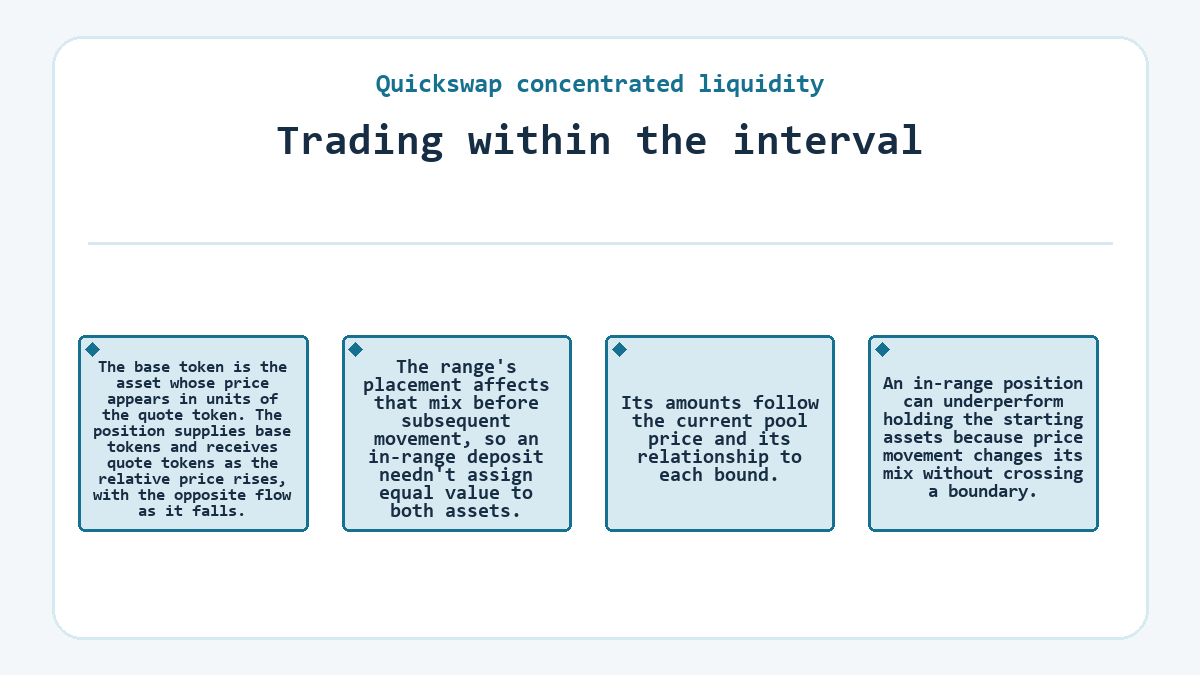
The base token is the asset whose price appears in units of the quote token. The position supplies base tokens and receives quote tokens as the relative price rises, with the opposite flow as it falls. The range's placement affects that mix before subsequent movement, so an in-range deposit needn't assign equal value to both assets. Its amounts follow the current pool price and its relationship to each bound. An in-range position can underperform holding the starting assets because price movement changes its mix without crossing a boundary.
Principal beyond a boundary
Liquidity principal consists of one asset beyond a bound, while accrued fees can still include either pool token. An out-of-range manual position stops earning new swap fees while the pool price remains outside its interval. An inactive position retains market exposure to that asset and can lose value even though swaps no longer change its principal amounts.
A return into the unchanged interval reactivates its liquidity; future swaps through that liquidity can generate new fees.
Manual positions and managed strategies
Manual V3 positions keep their chosen bounds until liquidity moves into a different position; managed strategies delegate range maintenance to a strategy contract. A standard manual position uses a non-fungible token (NFT) representing its individual range. Market movement changes its assets, while its lower and upper ticks remain fixed. Uncollected fees don't automatically enlarge its active liquidity. Reinvestment requires adding liquidity using the proportions appropriate to the price and range at that time.
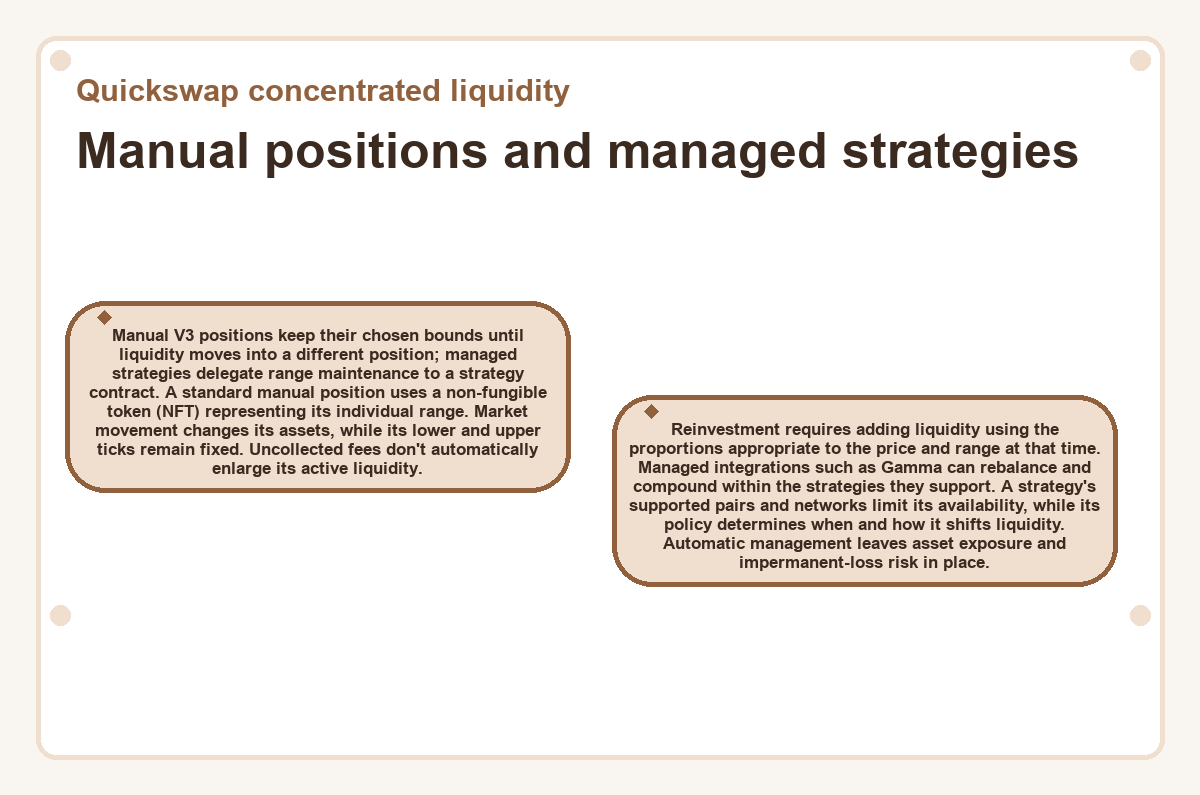
Managed integrations such as Gamma can rebalance and compound within the strategies they support. A strategy's supported pairs and networks limit its availability, while its policy determines when and how it shifts liquidity. Automatic management leaves asset exposure and impermanent-loss risk in place.
Quote direction, ticks and range presets
Quoted bounds identify a price relationship, and valid ticks restrict the exact boundaries the selected pool accepts. Inverting a token quote changes the numerical scale.
Token order and reciprocal bounds
The same economic range looks different when the interface reverses the quoted pair. Inversion makes the original upper price the reciprocal lower price, and the original lower price the reciprocal upper price. Check which asset the denominator represents before comparing two displays. A lower-looking number alone doesn't show a narrower range or cheaper asset.
Valid ticks and preset labels
Ticks divide the price curve into discrete boundaries, and each pool's tick grid restricts a position's permitted endpoints. A typed price may therefore snap to a valid boundary. Tick spacing and fee rules belong to the selected deployment. Range selectors can offer presets named Safe, Common or Expert, whose labels don't specify capital protection. The displayed lower and upper prices determine the interval you actually fund.
Repositioning costs and the holding benchmark
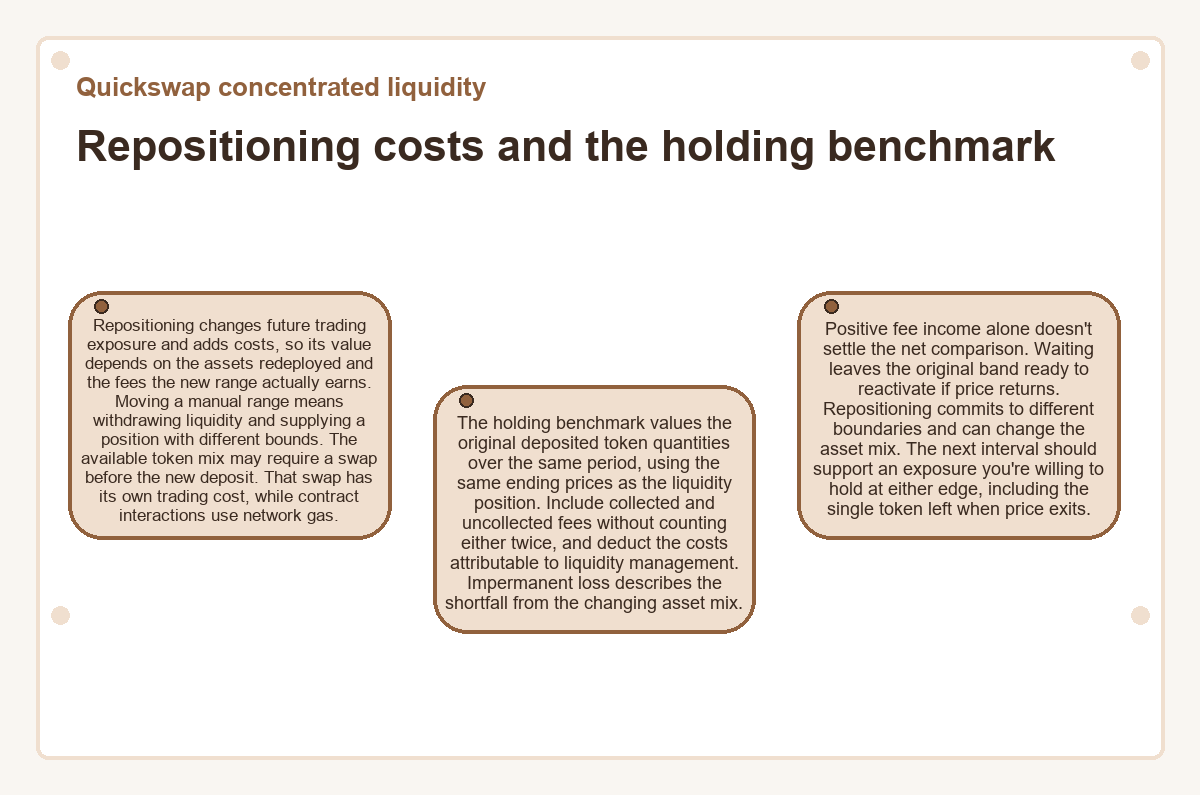
Repositioning changes future trading exposure and adds costs, so its value depends on the assets redeployed and the fees the new range actually earns. Moving a manual range means withdrawing liquidity and supplying a position with different bounds. The available token mix may require a swap before the new deposit. That swap has its own trading cost, while contract interactions use network gas.
The holding benchmark values the original deposited token quantities over the same period, using the same ending prices as the liquidity position. Include collected and uncollected fees without counting either twice, and deduct the costs attributable to liquidity management. Impermanent loss describes the shortfall from the changing asset mix. Positive fee income alone doesn't settle the net comparison.
Waiting leaves the original band ready to reactivate if price returns. Repositioning commits to different boundaries and can change the asset mix. The next interval should support an exposure you're willing to hold at either edge, including the single token left when price exits.
Quickswap concentrated liquidity - common questions
-
Can I collect V3 trading fees without withdrawing my liquidity?
- A manual V3 position can collect accrued swap fees without reducing its liquidity. Collection transfers owed tokens to the specified recipient. It leaves the chosen range in place and doesn't reinvest fees. The fee amounts can include both pool assets, irrespective of the principal's current mix.
-
Will a partial V3 withdrawal change the remaining price range?
- Removing part of a manual V3 position reduces its liquidity while preserving the remaining position's lower and upper ticks. The removed amounts follow the current pool price and chosen bounds. Partial removal doesn't recenter the remaining liquidity or switch it to Full Range.
-
How can I hold several price ranges in the same V3 pool?
- Separate manual V3 positions can cover different intervals in the same pool. Each position records its own bounds and liquidity. Holding several positions doesn't merge their limits. Fees accrue separately according to the prices each position covers and its share of active liquidity.
-
Does Full Range move a V3 deposit into a V2 pool?
- Full Range keeps a deposit in V3 and extends its coverage to the widest valid interval. It doesn't convert the position into V2 liquidity or adopt V2's fee accounting. The selected V3 pool still governs swap fees and position management, even when its price coverage resembles the earlier pool model.
-
When does a new V3 pool need an initial price?
- A new V3 pool needs price initialization before it can accept a manual position. The initial price establishes the pool's starting exchange ratio; the range sets that position's trading bounds. If the interface can't determine the starting ratio, entering a valid price is a prerequisite.